


Does Radiant Barrier Wear Out? What San Antonio Homeowners With Older TechShield Should Know
Short Answer
Yes, radiant barrier performance can decline over time, especially if the reflective surface is affected by dust, moisture, corrosion, physical damage, or poor installation. A properly installed radiant barrier can remain effective for decades, but older builder-grade systems should not be assumed to be performing like new simply because the material is still present. For San Antonio homeowners with 15+ year-old homes, especially those with original radiant barrier roof sheathing, an attic inspection can help determine whether the system is still reducing radiant heat effectively.
Key Takeaways
- Radiant barriers can lose effectiveness if the reflective surface is damaged, dirty, or affected by moisture.
- Older builder-grade systems may still be present even when attic temperatures remain extremely high.
- Radiant barrier must face an air space to work properly.
- Green Energy has recently found this issue in several 15+ year-old homes north of Loop 1604.
- An attic inspection can help determine whether the existing system is still performing as intended.
A Real San Antonio Attic Comparison
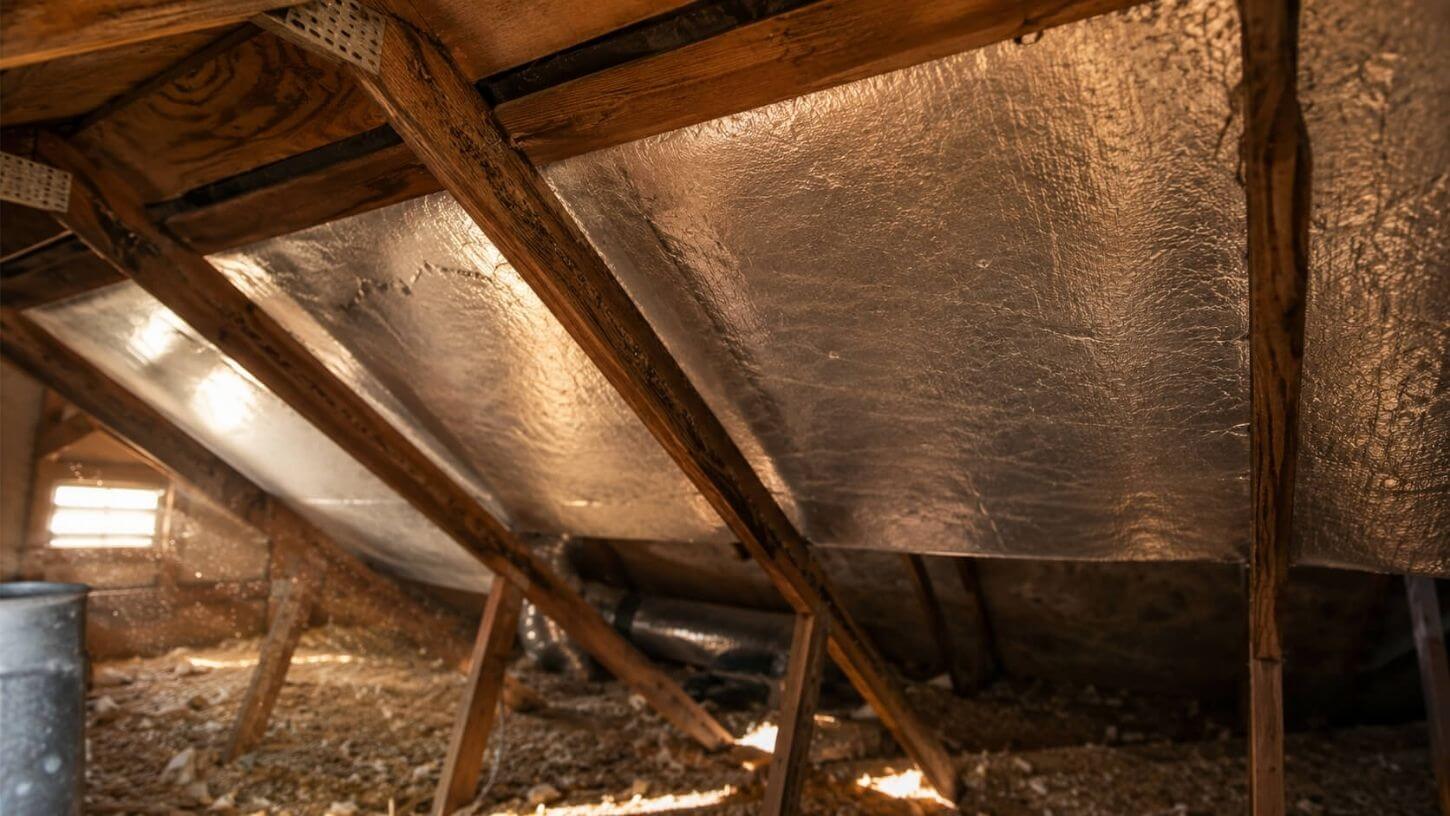
In August of 2026, with the outdoor temperature around 94°F, the Green Energy team inspected a home containing older TechShield radiant barrier roof sheathing. When standing in the attic, the temperature was around 130°F. Our team measured approximately 146°F in the portion of the attic beneath the existing TechShield roof sheathing. On the side where Green Energy's reflective system was being installed, the reading was approximately 116°F before the installation was even complete.
That 30-degree difference is a field observation from one job, not a controlled laboratory test, and every home is different. Direct sun, roof orientation, roofing materials, insulation, ventilation, time of day, measurement timing, and the location of the temperature reading can all affect attic temperature.
Still, seeing a home with reflective sheathing reach temperatures in the 140s is a good reason to inspect what is actually happening instead of assuming the original system is performing as designed.
The San Antonio sun can be relentless, especially on west- and south-facing roofs. Recently, we've been seeing similar issues on several recent projects involving older builder-grade systems in homes north of 1604. If your home is 15 years old or older, the condition of the reflective layer may be worth checking.
What a Radiant Barrier Actually Does
The system reduces radiant heat transfer. It does not work the same way as fiberglass or batt insulation, and it is not primarily measured by R value.
On a hot sunny day, the sun heats the roof shingles and other roofing materials. That heat moves through the roof deck and roof sheathing. The hot underside of the roof then emits thermal radiation toward cooler surfaces inside the attic space.
A low e surface is used to reflect heat and reduce that radiant energy moving from the hot roof toward the attic floor, ductwork, insulation, and other materials below. By reflecting radiant heat, the material helps reduce heat gain into the attic space.
Traditional attic insulation works differently. Fiberglass, fiberglass batts, and other insulation products primarily slow conductive heat flow through the attic floor and into the living space below. A house can benefit from both adequate insulation depth and a functioning low-emissivity layer because they address different types of heat transfer.
That is also why adding more insulation does not automatically replace the function of a reflective layer. High R values can help slow conductive heat, but they do not turn fiberglass into a low-emissivity surface.
Learn more about the difference between these systems in our guide to insulation options for San Antonio homes.
Why Radiant Barrier Needs an Air Space
The material must face an air space to reduce radiant transfer effectively.
If the foil side is pressed directly against another solid material, conduction can become the dominant form of heat transfer. The reflective face needs an air gap or open air space beside it so the low e surface can reduce thermal radiation across that space.
This is true whether the product is installed along rafters or incorporated into radiant barrier roof sheathing. In a roof-mounted system, the reflective face is generally on the underside of the roof deck and faces the attic space.
When installing a radiant barrier as a retrofit, proper spacing matters. The material should not simply be sandwiched tightly between other materials. An appropriate gap must be maintained according to the product and roof assembly.
The same principle applies near the attic floor. If reflective material is laid directly against insulation without the required open air space, it will not perform the same way as a correctly positioned reflective layer.
For a deeper explanation of the physics behind the system, read How Does Radiant Barrier Work?.
So, Can Radiant Barrier Performance Decline Over Time?
There is no universal 10-, 20-, or 30-year replacement schedule for the system.
The short answer is that the base material can remain effective for a long time, but the installed system can lose performance when conditions above the ceiling affect its low-emissivity face or its ability to face open space.
Research on radiant barriers has shown that performance depends heavily on installation method, surface condition, and long-term attic conditions. Roof-mounted applications can also have an advantage over horizontal applications because horizontal surfaces are more vulnerable to eventual dust accumulation.
A good reflective system may remain functional for decades. But homeowners should think about the entire installed system, not just whether some foil is still visible under the roof.
Dust Can Change Performance
Surface buildup is one of the best-documented ways a reflective face can lose performance.
A clean low-emissivity face has very low emissivity. When enough debris collects on that surface, it begins interacting with infrared radiation instead of allowing the aluminum surface to do all the work.
This is one reason installing a radiant barrier vertically or along the underside of the rafters can be preferable to placing a reflective layer flat on the attic floor. A horizontal surface tends to collect more debris.
Surface buildup does not mean every older system is useless. It means orientation and attic conditions matter when deciding whether an existing system is still effective.
Moisture, Oxidation, and Corrosion Can Matter
Moisture is another reason to inspect an older reflective system.
Not all reflective products are constructed the same way. Some use relatively thick aluminum foil. Others use an extremely thin metallized layer applied to another substrate. Surface oxidation may have little impact on substantial aluminum foil, while corrosion can have a much larger effect on some thin metallized products if the protective coating is compromised.
Oxidation, dust buildup, condensation, and other surface conditions can change the performance of highly reflective surfaces.
That is important in a hot, humid attic. If you see cloudy, dull, discolored, peeling, or visibly deteriorated reflective material, it is worth having the system inspected rather than assuming the appearance is purely cosmetic.
Moisture problems also need to be addressed at the source. Replacing a radiant barrier without understanding why part of the roof system is repeatedly wet does not solve the larger building problem.
Tears, Punctures, and Delamination
Physical condition matters too.
The system may be compromised by tears, punctures, detached sections, failed fasteners, or delamination of the reflective layer from the reflective sheathing.
With this type of roof product, the reflective layer is attached to the structural decking. If portions of that foil face are damaged or separated, the entire roof does not necessarily stop working, but the affected area may no longer provide the same radiant performance.
This is one reason an inspection is more useful than making a decision based only on the age of the house.
What Is Radiant Barrier Roof Sheathing?
Radiant barrier roof sheathing combines structural decking with a reflective layer on the underside.
Instead of adding a separate retrofit product later, builders can install panels during construction so the reflective face is already beneath the roof deck.
TechShield is one well-known example of this type of radiant barrier sheathing.
That does not mean every older TechShield installation is failing. The issue Green Energy is seeing locally is specific to the condition and performance of some older builder-grade systems it has inspected.
For a homeowner, the important question is not simply, "Do I have radiant barrier sheathing?" It is, "What condition is my radiant barrier sheathing in today, and what is my attic temperature actually doing?"
If you want to understand what properly functioning reflective insulation should be doing above your home, read How a Radiant Barrier Keeps Texas Homes Cool.
Why Older Homes North of 1604 Are Worth Checking
Many neighborhoods north of Loop 1604 saw significant residential construction roughly 15 to 25 years ago. In homes from that era, a builder may have used radiant barrier roof sheathing as part of the original roof system.
Now those houses are reaching an age where multiple parts of the building deserve a second look, including building materials, building-envelope details, and systems that influence interior comfort.
More years under the sun do not mean the radiant barrier automatically expires at year 15. It means years of San Antonio sun, roof heat, humidity, roof work, dust, ventilation, and normal building changes can reveal weaknesses that were not obvious when the home was new.
A hot attic can also have more than one cause. The existing reflective layer may be in poor condition, but insulation may also be low or uneven. Air leaks around ceiling penetrations can allow cooled indoor air to escape. Ventilation may be inadequate or obstructed. Roofing materials and roof orientation can also produce different temperature patterns.
That is why Green Energy recommends inspecting the system rather than assuming one product is responsible for every uncomfortable room.
Signs Your Existing Radiant Barrier May Need Attention
You do not need to climb into a 140°F attic to look for trouble yourself. In fact, you probably should not.
But there are signs inside the home that can justify an inspection:
- Upstairs rooms are consistently much hotter than downstairs rooms.
- One side of the house becomes difficult to cool every afternoon.
- Your cooling system runs for long periods on a hot sunny day.
- Your energy bill has increased even though your thermostat habits have not changed much.
- The home is 15 years old or older and still has its original radiant barrier sheathing.
- You recently had roof work and are unsure how the roof system or ventilation was affected.
- You have moisture stains, condensation concerns, or other evidence that the attic has been wet.
- An inspection shows a dull, peeling, damaged, or dirty foil face.
- The attic temperature remains extremely high despite having radiant barrier and adequate attic insulation.
None of those signs proves the radiant barrier has failed. They are reasons to evaluate the system as a whole.
Can an Old Radiant Barrier Make an Attic Hotter?
A deteriorated radiant barrier does not normally become a heat-producing material. The more accurate concern is that it may stop reducing radiant heat as effectively as expected.
If the low-emissivity face becomes less effective, more radiant energy can reach surfaces below the roof. Those surfaces absorb heat and can contribute to a higher overall temperature in the space above the ceiling.
So when a homeowner says an old radiant barrier is "making the space hotter," the practical issue is usually that the roof system is allowing more radiant heat into the space than a properly performing system would.
The sun can drive roof temperatures far above outdoor conditions. The difference can feel dramatic on a hot sunny day because roof shingles can reach temperatures far above the outdoor temperature.
There are a lot of misconceptions about what reflective insulation can and cannot do. We cover several of them in Radiant Barrier Myths Debunked.
How Can a Radiant Barrier Roof Affect Shingles?
Installing a radiant barrier can cause a small increase in roof shingle temperature because some radiant heat is redirected toward the roof.
Research has found relatively small increases in peak shingle temperature above roof-mounted radiant barrier systems, rather than the extreme temperature increases sometimes claimed online.
In other words, a correctly designed radiant barrier under roof shingles is not expected to damage shingles simply because it reflects radiant heat.
The shingles still experience normal solar heating, and they must remain installed according to manufacturer instructions. Those shingles are part of the complete roofing system.
If your home has asphalt shingles, the roof also needs to maintain appropriate ventilation and follow local building codes.
Homeowners concerned about an individual shingle warranty should review the actual terms issued by their roofing manufacturer before making changes to the roof assembly.
What Role Does Attic Ventilation Play?
The reflective system and attic ventilation do different jobs.
The reflective layer reduces radiant heat transfer. Attic ventilation supports air movement through a vented attic, typically using intake ventilation near the eaves and exhaust higher on the roof.
Soffit vents are one common source of intake ventilation.
These components serve different purposes and can be used together.
Green Energy of San Antonio offers attic ventilation only as an add-on when it is appropriate as part of a radiant barrier or attic insulation project. It is not offered as a standalone service.
Proper ventilation also matters when roofing systems are changed. The roof, insulation, air sealing, ventilation, and living space all interact as one building system that affects interior comfort and overall building performance.
Radiant Barrier vs. Attic Insulation
Radiant barrier and attic insulation should not be treated as competing products.
The reflective layer reduces radiant heat. Attic insulation slows conductive heat flow across the attic floor.
For example, fiberglass insulation with a high R value can slow heat moving toward the interior, but it does not have the same low-emissivity face used for reflecting radiant heat.
Likewise, the reflective layer does not replace the R value provided by fiberglass or other insulation.
If the attic floor has very low insulation levels, adding blown-in insulation may be an important part of the project. If insulation is already adequate but the roof is contributing heavy radiant heat, the reflective system becomes another part of the solution.
Green Energy of San Antonio focuses its attic insulation service on blown-in fiberglass and does not install spray foam.
Learn more about when these products may work together in our guide to insulation options for San Antonio homes.
Does Radiant Barrier Save Energy?
It can.
The amount depends heavily on climate, attic configuration, insulation, duct location, and the home's total cooling load.
Studies of hot-climate homes have documented reduced heat flow from the attic toward the home and measurable reductions in cooling demand after installing radiant barrier systems.
Those findings do not mean every San Antonio homeowner will save the same amount. A house with ducts in a very hot unconditioned attic may respond differently from a house with ducts inside the living area. A home with weak insulation may also respond differently from one with high R values.
The safest way to think about energy efficiency is that a functioning reflective system reduces one source of cooling load. Less radiant heat reaching the attic floor can mean less heat that your AC needs to remove from the interior.
That may lower energy costs, but no single energy bill reduction should be guaranteed.
If you're weighing the project financially, read more about what impacts radiant barrier installation cost in San Antonio.
Is Radiant Barrier Useful in a Cold Climate?
Radiant barrier physics do not stop working when the weather turns cold.
Thermal radiation moves between surfaces whenever there is a temperature difference. During colder conditions, a properly configured low-emissivity layer can reduce some radiant energy loss.
However, the financial value is typically greater in hot climates because solar radiation and roof heat create a much larger cooling load.
A hot-dry market such as Palm Springs has different conditions from San Antonio. For a cold climate home, traditional insulation, sealing gaps, and high R values usually play a larger role in controlling heating costs.
The design should be based on the local climate and local building codes rather than assuming a Texas attic strategy should be copied in every region.
Why the Attic Floor Still Matters
Even with an excellent reflective system, the attic floor remains a critical part of the thermal boundary.
The attic floor separates the unconditioned attic from the conditioned space in most vented-attic homes. Insulation across that floor slows conductive heat flow.
Gaps in insulation, compressed areas, and missing coverage around access points can all reduce performance. A radiant barrier cannot correct every problem at the ceiling plane.
This is why Green Energy looks at both the roof and attic floor before recommending a project.
Sometimes the better recommendation is to improve attic insulation. Sometimes the radiant barrier is the main opportunity. Sometimes both should be addressed.
Does Surface Buildup Mean You Need a New System?
Not always.
Dust accumulation is most concerning when the foil face is horizontal because dust can settle directly on the reflective face.
If the existing material is mounted beneath the roof and still clean, intact, and facing an open air space, normal age alone is not a reason to replace the system.
If the surface is heavily coated, physically deteriorated, detached, or visibly compromised, an inspection can help determine whether cleaning is realistic or whether a new system makes more sense.
Do not assume cleaning every reflective product is safe. Radiant barrier sheathing is part of the roof system, and aggressive scrubbing, chemicals, or pressure could damage the foil side or other materials.
Can a New Reflective System Be Installed With Existing Roof Sheathing?
Often, yes, depending on the attic configuration.
A retrofit generally does not require removing the entire roof or replacing structural decking simply because an older radiant barrier sheathing product is present.
A new reflective layer may be installed along the rafters so the new foil face faces the attic space. The exact installation method depends on framing, roof geometry, attic access, existing materials, ventilation, and local building codes.
The goal is to create a continuous low-emissivity face while preserving the necessary air space and not blocking required ventilation.
This is one reason professional installation matters. Installing a radiant barrier incorrectly can leave gaps, reduce coverage, block airflow, or place the foil against another material where it cannot perform as intended.
If you're considering doing the project yourself, first read How to Install Radiant Barrier in Your Attic the Right Way.
What About the Shingle Warranty?
Homeowners often worry that reflecting heat toward the roof will void the shingle warranty on their shingles.
Research has found only a relatively small increase in peak roof shingle temperature with properly installed radiant barrier systems.
But a shingle warranty is a legal document from the specific roofing manufacturer. The safest advice is to read the shingle warranty for your roof and verify installation requirements before altering the roof system.
This is especially important if the shingles were installed recently or the roof is still under a workmanship or manufacturer warranty. New shingles, replacement shingles, and older shingles can all carry different warranty terms.
Radiant barrier itself is not generally considered a reason for automatic shingle warranty cancellation. Improper roof work, blocked ventilation, or installation that violates a manufacturer's instructions can be a different issue.
What Homeowners Should Know About Builder-Grade TechShield
TechShield is not inherently a bad product. It is a form of radiant barrier roof sheathing designed to reduce radiant energy entering an attic.
The concern is condition, age, and actual performance.
A 15- or 20-year-old home may have undergone roof repairs, ventilation changes, moisture events, pest activity, electrical work, HVAC work, and years of extreme attic temperature swings and interior comfort changes. The reflective underside should be evaluated in the context of all of those factors.
Green Energy's recent San Antonio field observations show why that evaluation matters. In the homes the team inspected, having builder-installed radiant barrier sheathing did not prevent extremely hot attic conditions.
That does not prove all TechShield from that period has degraded. It does show why homeowners north of 1604 should not automatically assume the original system is still delivering the same performance just because the foil is visible.
When Should You Have Your Radiant Barrier Inspected?
Consider an inspection if:
- Your house is roughly 15 years old or older.
- Your home has original builder-grade reflective sheathing.
- Upstairs rooms have become increasingly difficult to cool.
- Your attic temperature is extremely high on summer afternoons.
- The foil face appears dull, damaged, peeling, or dirty.
- You have had roof leaks or other moisture problems.
- The roof or attic has undergone major work.
- You are planning to add attic insulation and want to understand the entire system first.
- You are replacing the roof and want to know how the existing reflective layer should be handled.
The inspection should consider more than the foil. Roof shingles, roof deck condition, attic ventilation, soffit vents, insulation coverage, leakage, ductwork, and moisture all affect overall attic performance.
Radiant Barrier FAQs
How long can radiant barrier last?
There is no single lifespan that applies to every product. High-quality materials can remain effective for decades when installed properly and kept in good condition.
The condition of the foil face, air space, moisture exposure, physical damage, and surface condition all matter more than the age printed on a calendar.
Can radiant barrier last 20 to 30 years?
It can. Some systems may last even longer.
But a 20-year-old system should be judged by condition and performance, not age alone. An intact foil system in a dry attic may perform very differently from damaged radiant barrier sheathing exposed to repeated moisture.
Can oxidation hurt radiant barrier performance?
It depends on the material and the severity of the surface change.
Thicker aluminum foil can remain highly reflective even with normal surface oxidation. Very thin metallized layers can be more vulnerable if their protective coating fails.
If an older foil face looks cloudy, deteriorated, or damaged, have it inspected rather than trying to identify the material by appearance alone.
Does radiant barrier need an air gap?
Yes. A reflective barrier must face an air space.
Without that air gap, direct contact allows conductive heat transfer and eliminates much of the benefit of the low-emissivity face.
Which way should the foil side face?
For a one-sided product, the foil side should face the open air space.
The exact orientation depends on the specific product and installation method, so manufacturer instructions should always be followed.
Can radiant barrier be installed over insulation?
The reflective material should not simply be pressed directly against attic insulation and expected to work as designed.
The reflective surface requires an air space. Horizontal placement above insulation can also make surface buildup more likely.
Does radiant barrier replace attic insulation?
No.
Radiant barrier reduces radiant heat transfer. Insulation provides R value and slows conductive heat flow. Many attics benefit from addressing both.
Can radiant barrier reduce attic temperature?
Yes. A properly installed system can significantly reduce roof-driven heat entering the attic, which can reduce attic temperature under the right conditions.
The actual temperature change depends on the roof, direct sun exposure, roofing materials, ventilation, insulation, weather, and measurement location.
Will radiant barrier damage my shingles?
A properly installed radiant barrier is not generally expected to damage roof shingles.
Homeowners should still follow roofing manufacturer requirements and review their individual shingle warranty when changing the roof assembly.
Does radiant barrier void a shingle warranty?
It should not automatically void a shingle warranty simply because radiant barrier is present.
However, individual shingle warranty terms and roof installation requirements still apply. If you are modifying a roof system, verify the warranty rather than relying on a blanket statement.
Does radiant barrier help in winter?
It can reduce radiant energy loss under some conditions, but the largest benefits are typically seen in hot climates where solar heat gain creates high cooling demand.
In a cold climate, insulation and sealing gaps are generally more important for controlling heating costs.
Will radiant barrier affect WiFi or cell phone service?
A properly installed attic radiant barrier should not prevent normal use of WiFi, Bluetooth, LTE, or cell phone service throughout the home.
The system does not create a completely sealed metal enclosure around the living space.
Read more about this concern in Do Radiant Barriers Affect Cell Phone Service?.
Have an Older Home North of 1604? Check What Your Attic Is Actually Doing
If your home is 15 years old or older and was built with reflective roof sheathing, you may already assume your attic is protected from radiant heat.
It may be. But the only way to know whether the system is still performing well is to look at its condition and the attic as a whole.
Green Energy of San Antonio has recently found older builder-grade reflective systems in homes north of 1604 where attic temperatures remained extremely high. In one recent field comparison, the existing TechShield side measured about 146°F while the area receiving Green Energy radiant barrier measured about 116°F before installation was complete.
That does not mean every TechShield roof needs replacement. It does mean homeowners with older reflective sheathing have a good reason to check rather than assume.
Green Energy of San Antonio can inspect the attic, review the existing foil face, evaluate attic insulation and ventilation, and explain what the home actually needs.
Contact Green Energy of San Antonio for a free attic evaluation and find out whether your existing reflective system is still helping your home handle the San Antonio heat.


